

Is The Template Strand Dna
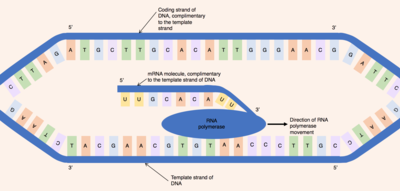
Position of the template and coding strands during transcription.
When referring to Deoxyribonucleic acid transcription, the coding strand (or advisory strand [1] [2]) is the DNA strand whose base sequence is identical to the base sequence of the RNA transcript produced (although with thymine replaced past uracil). Information technology is this strand which contains codons, while the non-coding strand contains anticodons. During transcription, RNA Pol 2 binds to the non-coding template strand, reads the anti-codons, and transcribes their sequence to synthesize an RNA transcript with complementary bases.
By convention, the coding strand is the strand used when displaying a DNA sequence. Information technology is presented in the 5' to three' direction.
Wherever a factor exists on a Deoxyribonucleic acid molecule, 1 strand is the coding strand (or sense strand), and the other is the noncoding strand (also chosen the antisense strand,[3] anticoding strand, template strand or transcribed strand).
Strands in transcription bubble [edit]
During transcription, RNA polymerase unwinds a short department of the DNA double helix near the get-go of the gene (the transcription get-go site). This unwound department is known as the transcription chimera. The RNA polymerase, and with it the transcription bubble, travels along the noncoding strand in the opposite, iii' to 5', management, too as polymerizing a newly synthesized strand in v' to 3' or downstream direction. The Dna double helix is rewound by RNA polymerase at the rear of the transcription bubble.[3] Like how two next zippers work, when pulled together, they unzip and rezip as they proceed in a particular direction. Various factors can cause double-stranded Dna to break; thus, reorder genes or cause cell expiry.[four]
RNA-Deoxyribonucleic acid hybrid [edit]
Where the helix is unwound, the coding strand consists of unpaired bases, while the template strand consists of an RNA:DNA blended, followed past a number of unpaired bases at the rear. This hybrid consists of the nigh recently added nucleotides of the RNA transcript, complementary base-paired to the template strand. The number of base-pairs in the hybrid is under investigation, but information technology has been suggested that the hybrid is formed from the last 10 nucleotides added.[v]
See as well [edit]
- Sense strand
- Sense (molecular biological science)
References [edit]
- ^ "28.4: Transcription of DNA". Chemistry LibreTexts. 2015-08-26. Retrieved 2021-09-06 .
- ^ STOKER, H. STEPHEN (2013). General, Organic, and Biological Chemistry. Cengage Learning. p. 816.
- ^ a b Lewin, Benjamin (2008). Genes Nine. Oxford University Press. p. 129, 235. ISBN978-0-7637-4063-4.
- ^ Dianatpour A, Ghafouri-Fard South (2017). "The Role of Long Not Coding RNAs in the Repair of Deoxyribonucleic acid Double Strand Breaks". International Journal of Molecular and Cellular Medicine. six (i): ane–12. PMC5568187. PMID 28868264.
- ^ Griffiths 2005, pp. 259–265
Works cited [edit]
- Griffiths, A.J.F.; et al. (2005). Introduction to Genetic Analysis (8th ed.). Westward.H. Freeman. ISBN0-7167-4939-iv.
- Lewin, B. (2000). Genes VII . New York: Oxford University Printing. ISBN0-19-879277-8.

Is The Template Strand Dna,
Source: https://en.wikipedia.org/wiki/Coding_strand
Posted by: rondonsecandent.blogspot.com
0 Response to "Is The Template Strand Dna"
Post a Comment